 |
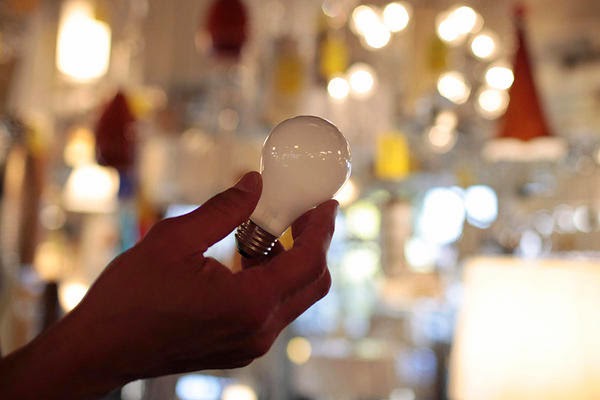
| (A man holds up a light bulb. Energy-efficient light bulbs like CFLs and LEDs have higher initial costs, but can save help save money in the long run. Photo by Jae C. Hong/AP/File) Image Source: csmonitor.com |
Buying a light bulb used to be easy. You headed to the store, chose bulbs with your desired wattage, handed over a few bucks, and were on your way. Today, navigating the light bulb section is much harder, thanks to new energy-efficient types of light bulbs like CFLs and LEDs that come with a much higher price tag, as well as a staggering array of options.
To help with your decisions, we looked at the basic terms and light bulb types affiliated with this new generation of options, and compared them to the ones consumers are traditionally used to. Although the initial costs are higher, new forms of light bulbs are not only better for the environment, but they'll also save you money in the long run — if you choose correctly for your needs.
Know these terms: Watts and lumens
Simply speaking, watts are the amount of electricity a bulb uses to produce light. The less wattage, the less energy used. Traditionally, they were the deciding factor for purchase, and you had four choices – 40, 60, 75, or 100. (More on those numbers later.)
Today, it's all about the lumens, which measure the amount of light emitted from a bulb. More lumens equal brighter light. To replace standard wattage light bulbs based on lumens, use the following general rules:
- 40 watts: Look for at least 450 lumens
- 60 watts: Look for at least 800 lumens
- 75 watts: Look for at least 1,100 lumens
- 100 watts: Look for at least 1,600 lumens
Types of light bulbs
Incandescent light bulbs: The cheapest option
If you're a fan of the standard 40, 60, 75, and/or 100-watt bulb, you might want to stock up. As part of the Energy Independence and Security Act of 2007, they were phased out in favor of more energy-efficient models. While you can still find them in some stores — or buy them by the case on eBay — they're no longer being produced.
The new incandescents are more energy-efficient, but still pale in comparison to the life span of CFLs and LEDs. A typical bulb will last for about 1,000 hours. Still, if you're looking for the lowest price tag on light bulbs, incandescent bulbs are your best bet at around $1 to $2 each.
CFL bulbs: Mid-level pricing, moderate energy savings
Compact fluorescent light (CFL) bulbs have been around for a while, and they're best known for their spiral design. They typically last for about 10,000 hours, and use much less energy than incandescents – about 75 percent less. Cost-wise, they'll cost you more than incandescent bulbs, as they start at around $4 each. According to the US Department of Energy, you'll recoup that cost in energy savings within nine months.
CFLs don't brighten as quickly as incandescent or LED bulbs, so they aren't great choices for entryways, or any place where you need immediate light. They also don't work well in the cold, so for outdoor use in cold climates, incandescents or LEDs would be a better bet. And CFLs also contain small amounts of mercury, so you shouldn't throw them in the trash. Both Home Depot and Lowe's offer CFL recycling programs.
 |
| Image Source: surelight.ca |
LED light bulbs: Most expensive, highest energy savings
Light emitting diode (LED) bulbs use even less energy than CFLs, and they last longer: up to 50,000 hours. Unlike CFLs, they brighten instantly, even in cold temperatures. Using LEDs can help you save up to 80 percent in energy costs per year.
LEDs come with a heftier price tag than CFLs or incandescents – they start at around $10 each. If you have a light fixture you barely use, you might want to opt for a CFL or incandescent instead, as you may not recoup the cost in energy savings.
Light bulb features: Choosing the right bulb for your needs
Energy-efficient light bulbs come in different sizes, shapes, and colors, and it can be difficult to determine which will work best in your fixtures. When all else fails, bring your old light bulb to the store and ask for help, but get acquainted with these features first.
Lighting facts label
All new light bulbs are now required to have this, which lists lumens, watts, lifespan, light appearance, and yearly savings. This label makes it easy to compare different models and see which type meets your needs and which will save you the most money.
Dimmers and 3-way fixtures
Standard CFLs often don't work in dimmers, and some LEDs don't, either. All three types, in fact, offer bulbs specifically for those purposes, so look for that designation on the package. Also look for designations for outdoor lighting.
Colors
If you want lighting that resembles the warm color of standard incandescent bulbs, look for something on the "warm" end of the lighting facts label, or about 2,500 Kelvin. The higher you go, the more white the light will be. 5,000K and up mimics natural daylight.
Shapes and sizes
Each package has a letter and number code on it. The letter is the shape, and will stand for standard (A), globe (G), bullet (B), candle (C), flare (F), reflector (R), sign (S), or tubular (T). The size numbers reflect the diameter of the bulb at its widest point.
ENERGY STAR
ENERGY STAR is a labeling program by the US Environmental Protection Agency and the US Department of Energy that identifies energy-efficient products and buildings. In order for products to receive the ENERGY STAR label, they must meet an established set of criteria for efficiency. And if you buy ENERGY STAR-certified light bulbs, you may be able to receive special offers and rebates. Simply enter your zip code on the website and select the type of light bulbs you want to buy (as well as any other ENERGY STAR products you're interested in).
 |
| Image Source: energystar.gov |
The bottom line: Consider savings now and savings later
If you're looking for instant savings, energy-efficient incandescents are the way to go. If you're looking long-term cost benefits, CFLs and LEDs will save you more money in the long run.
What types of light bulbs are you using in your home? Have you noticed any savings from energy-efficient models?
Sureway International offers a wide range of lighting products for home and business use. Get more tips on lighting and energy conservation on this blog.


